Madrid, una sinfonía de torres sobre el lienzo de la meseta

Madrid, a symphony of towers on the plateau canvas

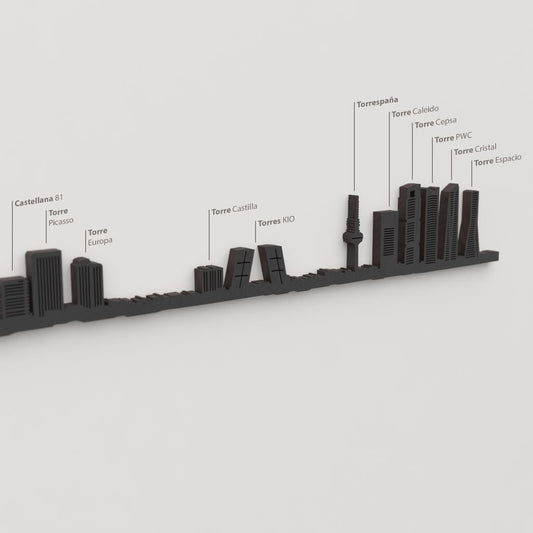
From the Cerro del Tío Pío, the Madrid skyline is revealed as a canvas in which historical solemnity and contemporary verticality intertwine. The view runs from the domes and towers of the Almudena and the Royal Palace, across the Gran Vía with the Metrópolis and Telefónica, towards the towers of AZCA and Chamartín. The skyline unfolds over the plateau, with the Sierra de Guadarrama in the distance and the silhouette of Madrid gently ascending on the Castellana axis.

History and design

We approach the reading of the Madrid skyline as a sequence that starts at the historic promontory of the Almudena-Palacio Real and develops along the Castellana axis. The radial structure of the city and the orthogonal expansions of the 19th century are translated into a volumetric staggering that goes from baroque bell towers to post-war rationalism and to the corporate architecture of the 21st century. Our team analyzed urban plans, topographic sections and aerial photographs to establish the hierarchy of heights and the gradient of visual density. We observed how the historical landmarks (Royal Palace, Almudena Cathedral) dialogue with the emergences of Gran Vía (Metrópolis, Telefónica) and the AZCA towers (Castellana 81, Picasso, Europa). The evolution continues in the inclined towers of KIO and culminates in the Five Towers Business Area, which introduce a new horizon of steel and glass. We decided to highlight this vertical crescendo through a linear composition that respects the horizontality of the plateau and the softness of the watercourses.

The creative process

From the Tío Pío hill we undertook a longitudinal section analysis to gauge the relationship between the hill and the Castellana axis. We evaluated the skyline and graded the heights so that the landmarks would emerge in a coherent cadence: first the historic towers, then the Gran Vía skyscrapers and finally the AZCA and Chamartín towers. We adjusted the framing so that the cut of the plateau emphasized the continuity between built mass and urban voids, allowing the horizontal progression to become legible. Our team considered the characteristic lighting of Madrid, the clarity of the air and the golden tones of the brick and granite, integrating the shadows cast in the composition.

The buildings along the route

These buildings are the landmarks that articulate the identity of the Madrid skyline and its symbolic value. They represent the transition between the Hapsburg Madrid and the global metropolis, marking the turning points of the Castellana axis. Almudena Cathedral, Royal Palace, Telefónica Building, Picasso Tower, KIO Towers, Five Towers and Torrespaña make up a coherent sequence that symbolizes the architectural evolution of the capital.

Back to blog

Almudena Cathedral

The great royal church. Located in front of the Royal Palace, its varied architecture and neoclassical dome make it a central point. It is the main Catholic temple of Madrid and the spiritual heart of the city.

Telefónica Building

The first skyscraper in Spain. This building on Gran Vía, inaugurated in 1929, was a pioneer in its height. Its imposing silhouette marked the beginning of modernity in Madrid architecture.

Picasso Tower

A glass cube that transformed the landscape. The work of architect Minoru Yamasaki, this tower was for years the roof of Madrid. Its timeless design stands as an icon of the financial architecture of the 1980s.

Almudena Cathedral

The great royal church. Located in front of the Royal Palace, its varied architecture and neoclassical dome make it a central point. It is the main Catholic temple of Madrid and the spiritual heart of the city.

Telefónica Building

The first skyscraper in Spain. This building on Gran Vía, inaugurated in 1929, was a pioneer in its height. Its imposing silhouette marked the beginning of modernity in Madrid architecture.

Picasso Tower

A glass cube that transformed the landscape. The work of architect Minoru Yamasaki, this tower was for years the roof of Madrid. Its timeless design stands as an icon of the financial architecture of the 1980s.

KIO Towers (Puerta de Europa)

The leaning gates of Madrid. These twin towers, with their striking inclination, greet those entering the capital from the north. They are a unique architectural landmark and a symbol of innovation.

Torrespaña (Pirulí)

The beacon of communications. This iconic telecommunications tower dominates the skyline with its height and characteristic shape. It is a functional and visible element that has become a modern symbol of the city.

The Five Towers of Madrid (CTBA)

The poker of modernity. This skyscraper complex redefines Madrid's northern skyline. The four large towers (and the more recent fifth) symbolize the financial power and ambition of the capital in the 21st century.

KIO Towers (Puerta de Europa)

The leaning gates of Madrid. These twin towers, with their striking inclination, greet those entering the capital from the north. They are a unique architectural landmark and a symbol of innovation.

Torrespaña (Pirulí)

The beacon of communications. This iconic telecommunications tower dominates the skyline with its height and characteristic shape. It is a functional and visible element that has become a modern symbol of the city.

The Five Towers of Madrid (CTBA)

The poker of modernity. This skyscraper complex redefines Madrid's northern skyline. The four large towers (and the more recent fifth) symbolize the financial power and ambition of the capital in the 21st century.

  • The city that drew its history in the sky, from the palace domes to the glass towers.

Collapsible content

Descrizione

From the Cerro del Tío Pío a panoramic view begins with the domes of the Almudena Cathedral and the volume of the Royal Palace; as the view follows the axis of the Castellana to the northwest, the towers of the Gran Vía emerge, such as the Telefónica Building and the Metrópolis. Further along, the AZCA towers emerge - Castellana 81, Picasso, Europa - and the leaning towers of KIO, until reaching the Five Towers complex. All this, framed by the Madrid plateau and the distant silhouette of the Sierra de Guadarrama.

Fatto storico

The Madrid skyline was formed from the Madrid of the Habsburgs, which was projected on the promontory of the Almudena and the Royal Palace. Nineteenth-century extensions expanded the city towards the Castellana, and the Gran Vía introduced the first high-rise architecture in the early twentieth century. After the postwar period, the development of the AZCA financial district and, later, of Chamartín with the Five Towers consolidated the corporate verticality. This fabric superimposes baroque bell towers, rationalist skyscrapers and 21st century towers.

Giustificazione

We selected the landmarks that structure the Madrid skyline along the Castellana axis. The Almudena Cathedral and the Royal Palace anchor the historical base; the Telefonica Building inaugurates the modern verticality; the AZCA towers represent the financial boom of the 20th century; the sloping KIO Towers mark the transition; and the Five Towers Business Area culminates the progression. We understand that this sequence synthesizes the evolution of Madrid and maintains a visual balance between heritage and modernity.

  • From the top of the Cerro del Tío Pío, the golden light of dawn caresses the domes of the Almudena and the Royal Palace; the plateau extends towards the Sierra de Guadarrama and the gaze follows a symphony of towers that marks the rhythm of time.

  • As night falls, Gran Vía becomes a river of neon; the Telefónica Building and the Metrópolis illuminate the stone and granite, while traffic whispers and the early verticality dialogues with the modernity of AZCA to the rhythm of the city.

  • The KIO Towers lean like steel doors open to the north; beyond, the Five Towers rise like glass spires that pierce Madrid's clear sky and reflect the snow of the Sierra, marking the corporate skyline.

  • In the meadow of San Isidro, the sound of the barrel organ and chotis mixes with the aroma of donuts; carnations dance in the wind and the silhouette of Madrid is cut with the Royal Palace and the towers, wrapping the party with a horizon of stone and light.

The history of Madrid, engraved on wood

The Madrid skyline is more than a line of buildings; it is an urban biography written in stone, brick and glass. Each tower and dome is a chapter that narrates the evolution from a royal villa to a global metropolis, a constant ascent over the horizontality of the plateau. This wooden piece condenses that journey in time, from the solemnity of the Royal Palace to the audacity of the Five Towers.

Continue exploring the world