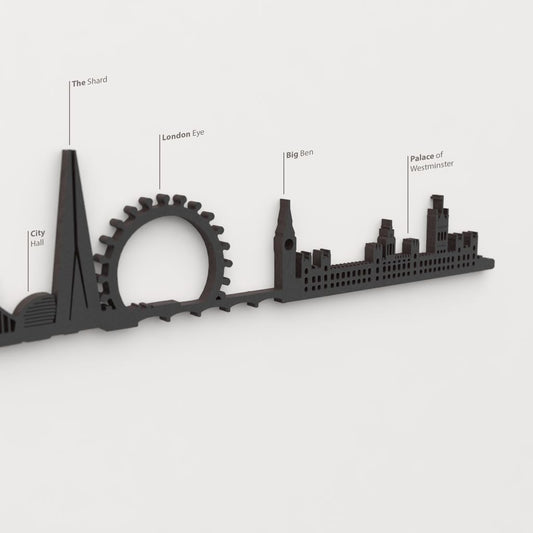
London, the story told by the Thames in stone and glass
From Westminster, following the course of the Thames eastward, the London skyline unfolds like a score where Victorian stone blends with contemporary steel and glass. We observe Parliament and its clock tower, while the wheel of the London Eye turns smoothly on the South Bank and the sharp profile of The Shard rises on the horizon. The reflection of bridges and towers over the river adds depth to the scene, and the succession of historic and modern landmarks tells the story of the capital.
History and design
We approach the evolution of London's skyline as a linear sequence anchored by the river, where early Gothic and Norman structures coexist with high-tech skyscrapers. The medieval core of Westminster and the City are characterized by low-rise and irregular plots; the Thames acts as an organizing axis of bridges, towers and visuals. We detect a pattern of densification to the east: from Big Ben and the London Eye to The Shard and the City cluster, where structures such as 30 St Mary Axe and 22 Bishopsgate introduce a biomimetic and aerodynamic verticality.
The creative process
We started our visual composition from water level, calibrating the longitudinal section of the Thames so that the landmarks followed one another in a legible cadence. We decided to make the river the protagonist, letting its reflections link the Westminster structures with the City towers. We evaluated the interplay of materials - limestone, brick, steel and glass - and how their interaction with the evening light generated tonal changes that had to be integrated into the narrative. Using these criteria, we achieved a fluid representation that shows the London skyline as a continuous story of engineering and symbolism.
The buildings on the tour
We selected these architectural landmarks because they condense the essence of London and mark the transition from past to present. Big Ben, London Eye, The Shard, Tower Bridge, Tower of London and 30 St Mary Axe make up a sequence where each piece orients the eye and defines a symbolic landmark of the urban skyline.