Madrid, a symphony of towers on the plateau canvas
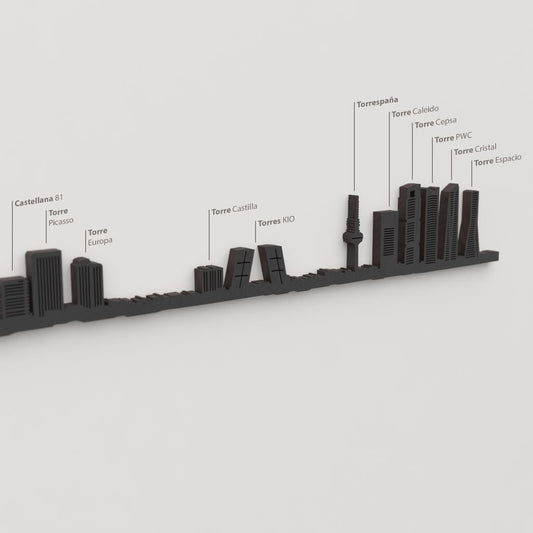
From the Cerro del Tío Pío, the Madrid skyline is revealed as a canvas in which historical solemnity and contemporary verticality intertwine. The view runs from the domes and towers of the Almudena and the Royal Palace, across the Gran Vía with the Metrópolis and Telefónica, towards the towers of AZCA and Chamartín. The skyline unfolds over the plateau, with the Sierra de Guadarrama in the distance and the silhouette of Madrid gently ascending on the Castellana axis.
History and design
We approach the reading of the Madrid skyline as a sequence that starts at the historic promontory of the Almudena-Palacio Real and develops along the Castellana axis. The radial structure of the city and the orthogonal expansions of the 19th century are translated into a volumetric staggering that goes from baroque bell towers to post-war rationalism and to the corporate architecture of the 21st century. Our team analyzed urban plans, topographic sections and aerial photographs to establish the hierarchy of heights and the gradient of visual density. We observed how the historical landmarks (Royal Palace, Almudena Cathedral) dialogue with the emergences of Gran Vía (Metrópolis, Telefónica) and the AZCA towers (Castellana 81, Picasso, Europa). The evolution continues in the inclined towers of KIO and culminates in the Five Towers Business Area, which introduce a new horizon of steel and glass. We decided to highlight this vertical crescendo through a linear composition that respects the horizontality of the plateau and the softness of the watercourses.
The creative process
From the Tío Pío hill we undertook a longitudinal section analysis to gauge the relationship between the hill and the Castellana axis. We evaluated the skyline and graded the heights so that the landmarks would emerge in a coherent cadence: first the historic towers, then the Gran Vía skyscrapers and finally the AZCA and Chamartín towers. We adjusted the framing so that the cut of the plateau emphasized the continuity between built mass and urban voids, allowing the horizontal progression to become legible. Our team considered the characteristic lighting of Madrid, the clarity of the air and the golden tones of the brick and granite, integrating the shadows cast in the composition.
The buildings along the route
These buildings are the landmarks that articulate the identity of the Madrid skyline and its symbolic value. They represent the transition between the Hapsburg Madrid and the global metropolis, marking the turning points of the Castellana axis. Almudena Cathedral, Royal Palace, Telefónica Building, Picasso Tower, KIO Towers, Five Towers and Torrespaña make up a coherent sequence that symbolizes the architectural evolution of the capital.